The energy transition has a technology story most people in the space know well. Costs falling, capacity rising, the grid changing shape. What gets less attention are the rules that determine who can participate and on what terms, the organizational will required to actually move, the delivery infrastructure that makes the journey navigable for real people, the products and interfaces that make clean energy something worth choosing, the narratives that build a public ready for what's coming. These are design challenges.
Below, we’ll explore six disciplines, starting at highest altitude and working down, including policy design, service design, transition design, strategic design, organizational design, user experience design, product design, and communications design, as they relate to the energy transition. In each, you’ll get a brief summary of what the discipline is, an example or case study, and some seeds for opportunities with each. Importantly, these aren't parallel tracks, they operate at different altitudes of the same system. Policy sets the conditions, transition design holds the horizon, strategic design builds organizational will, organizational design builds around the strategic imperative, service design operationalizes it, product/UX makes it desirable, communications makes it legible.
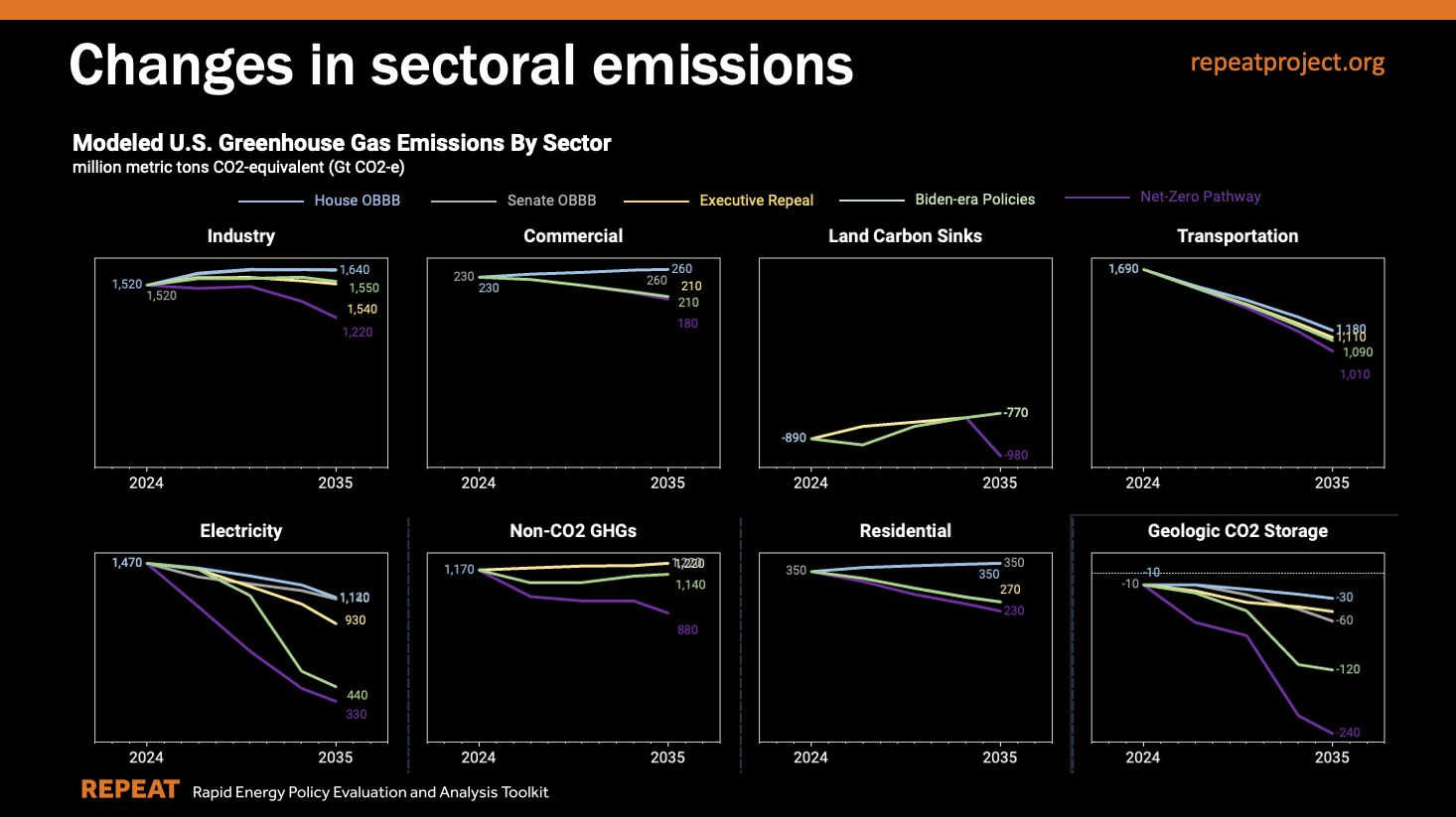
Chart via Dan Hill talk on Strategic Design for Rosenfeld
Policy Design
How do you make new rules when the old ones struggle to serve the moment? Policy design is the intellectual and political process of defining what government intends to do about a particular issue and why. It’s a conscious and deliberate effort to define what policy seeks to achieve and map out how those aims will be reached instrumentally, creating the actual laws, regulations, guidelines, and action plans that will guide government efforts. When done well, it solves or meaningfully addresses relevant social problems while advancing the interests of various stakeholders, though this often involves navigating competing demands. We already see the impact of policy design in the space at a global and domestic markets level. The graphic below shows how various legislative contexts impact changes in sectoral emissions, partly due to energy policies.
Germany for much of this century was seen as a leader in clean energy, because of its use of policy design to support the development and use of technologies like solar, wind, hydro, and geothermal. One significant policy instrument they used were feed-in tariffs, a policy mechanism that accelerate investment by providing remuneration above the retail or wholesale rates of electricity. Essentially, it reduces risk for renewable energy producers. Germany’s aim was to promote renewable energies in order to increase the share renewable energy in the electricity mix and produce no greenhouse gas emissions (GHG) for a healthy environment and sustainable wealth creation for future generations. The policy was massively successful, driving production of electricity from renewable sources in Germany from 6.2% in 2000 to about 28 % in 2014, with the potential for reaching 100% by 2030. This model has become an archetype for similar legislation in more than 80 countries worldwide, including China, who now leads the world in solar production. The tariffs drove renewable energy from 6.2% in 2000 to 28% by 2014.
While Federal incentives and regulatory support in the US are diminishing and becoming increasingly fragmented, (I recommend following Michael Thomas’ Cleanview on LinkedIn for excellent reporting on how policies are impacting alternative energy markets) there is increased opportunity for more localized, community-driven policy design approaches. For example, municipal policy innovation cities like Austin and San José that are experimenting with designing hyperlocal policies that bypass state and federal gridlock, creating "policy labs" that test innovative approaches to renewable energy deployment and community ownership models. At a community level, indigenous nations and local communities are pioneering policy frameworks that center energy sovereignty and community ownership, such as the Navajo Nation's renewable energy codes that prioritize tribal economic development alongside climate goals. And major corporations are essentially creating their own "policy ecosystems" through renewable energy procurement standards that drive market transformation faster than government regulation, demonstrating how private sector policy design can accelerate clean energy transitions.
Policy sets the rules. But rules don't move systems, especially systems that have been operating on and reinforcing the same, increasingly outdated logic. That's where transition design comes in.
Transition Design
What interventions most effectively entrench clean energy into our ways of living, working, and exchanging? How do we intervene in systems that are self-reinforcing, politically entrenched, and operating at multiple scales simultaneously, without just optimizing the existing logic of undesireable conditions? Transition Design’s response is a transdisciplinary approach based in the understanding that these problems are interconnected, interdependent and always manifest in place and culture-specific ways. Transition Design argues that the societal transitions we are currently _in_, are heading toward futures we don’t necessarily _want_. But, it also contends that we can _intentionally shift our_ _transition trajectories_ toward futures we _do_ want.
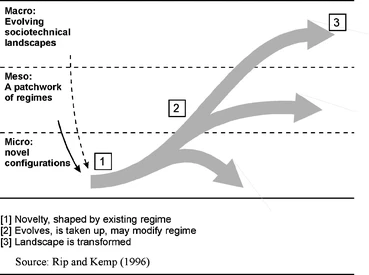
By 2050, the Netherlands wants to be using energy from sustainable sources only, and has designed a systemic approach that coordinates technological, social and policy transitions simultaneously. (source - note this is a very simple, logical breakdown of core components of an energy transition) The Dutch transition approach relies on guided processes of variation and selection, and it makes use of 'bottom-up' developments and long-term thinking. A set of multiple transition paths are being traversed (including biomass for electricity, clean fossil, micro co-generation, energy-producing agricultural greenhouses). The government acts as a process manager, dealing with issues of collective orientation and interdepartmental coordination. (It’s worth also checking out the Dutch energy system transition scenarios.)
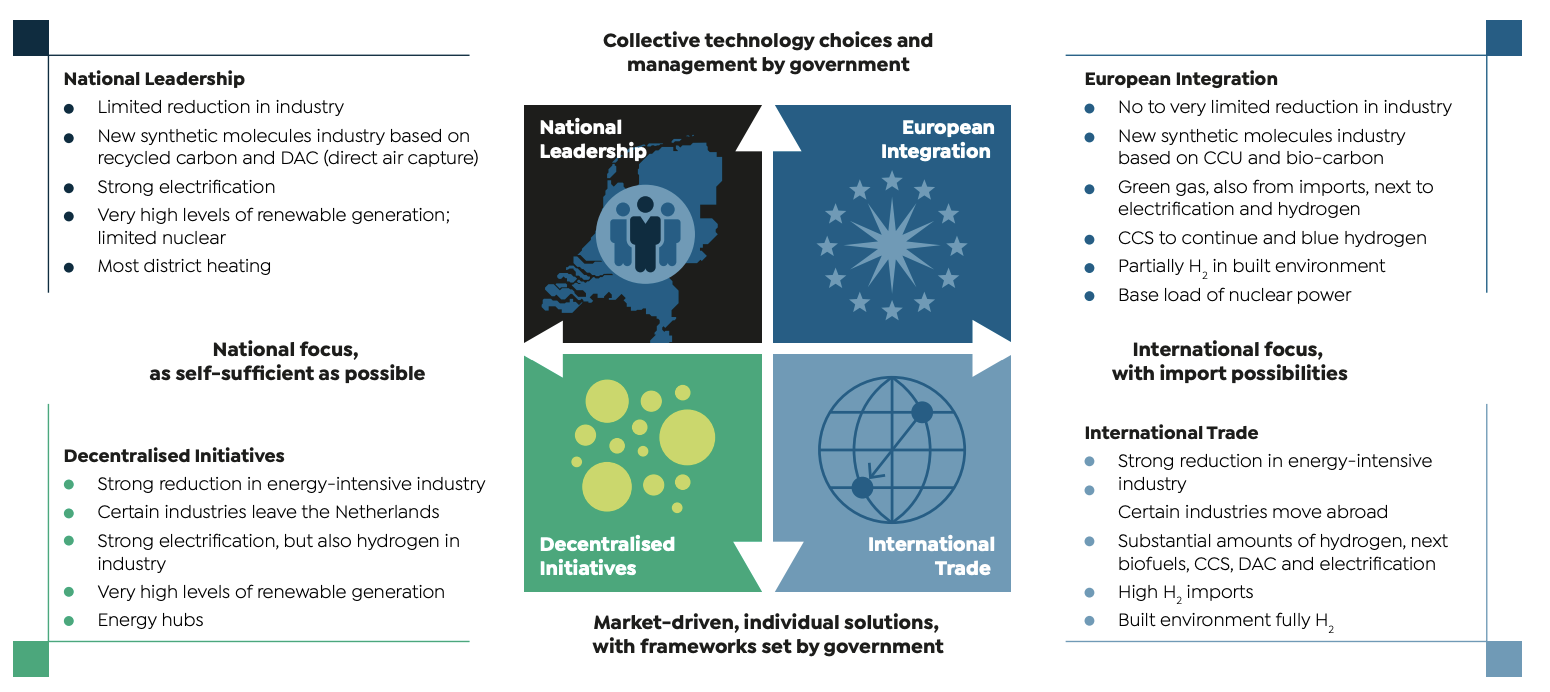
Transitioning to clean energy requires extensive and thoughtful strategic partnerships, financial approaches, solutions based in both human and environmental needs. The more value and needs that can be met, the more impactful the design. Here are some opportunities that are arising in a volatile policy and economic market.
- Governance: Creating governance frameworks that treat renewable energy as a shared resource across bioregions, designing new institutional forms that coordinate solar, wind, and storage across state lines while respecting local sovereignty and ecological boundaries.
- Workforce development and safety nets: Designing transition processes that center displaced fossil fuel workers and frontline communities, creating retraining programs, community ownership models, and economic development strategies that ensure renewable energy transitions strengthen rather than abandon industrial communities.
- De-siloed, co-catlyzing solutions: Moving beyond "sustainable" to design energy systems that actively restore ecosystems, such as agrivoltaics that enhance soil health, offshore wind that creates marine protected areas, and battery mining that funds land restoration.
- Transition journeys: Designing for multiple time horizons simultaneously - emergency climate response, generational wealth building, and centuries-long ecological stewardship - creating energy infrastructure that serves immediate needs while building toward long-term community resilience.
- Cultural Transitions: Designing energy systems that align with diverse cultural values and practices, such as Indigenous energy sovereignty projects, religious community solar cooperatives, and neighborhood-scale energy sharing that strengthens social bonds.
In fact, each of the types of design named in this piece are a tool in the transition design toolbox. Transition design operates at the longest horizon, and strategic design is how organizations actually build the capacity to move toward it, making the 50-year vision legible enough to act on today.
Strategic Design
According to Dan Hill, a leading thinker in strategic design, “Strategic design takes the core principles of contemporary design practice – user research and ethnography, agile development, iterative prototyping, participation and co-design, stewardship, working across networks, scales and timeframes – and then it points this toolkit at ethical concerns, addressing systemic change within complex systems, and broader societal outcomes. Design’s ‘real world’ task at this point must involve balancing individual needs with wider societal outcomes, applying itself to ‘big picture’ systemic challenges like health, education, inequality, and climate change, helping redefine how problems are approached or how questions are framed, before identifying and conveying multiple opportunities for action.” Citing the congestion (and not to mention sexual assault) issues that arise with Uber, he writes, “In other words, individually-focused interaction design can produce Uber, but not a good city with Uber in it. This means we need a form of design that can take a broader view, deploy a richer toolkit towards a greater goal, and particularly, embed itself into a re-tooled and engaged public sector.” In energy, strategic design aligns business models, stakeholder interests, environmental outcomes, human needs, and market dynamics to create viable pathways for renewable energy scaling.
In 2010, Danish energy company, Ørsted, made most of its money from fossil fuels, 85 percent of which came from coal. By 2019, it had reduced greenhouse gas emissions by 83% (since 2006) and is now the world’s leading offshore-wind power producer. It’s strategy and vision was called 85/15, stating a change in generation mix from 85 percent conventional, 15 percent renewable to 85 percent renewable, 15 percent conventional. The question was how to do that. “Answering that question involved a 360-degree review: the supply chain, our competencies, the financing models. We concluded that we could not do it alone,” according to CEO Martin Neubert. Installation companies were small, introducing risk that they would go bankrupt. So Ørsted acquired an installation supplier. Suppliers that could handle the scale were critical. At one point in the process, a drop in gas prices in the US and a flux of US coal in europe created financial issues, and a group of European utilities active in offshore wind in the UK, moving to establish a wind-power business unit to build on the momentum in the UK. Financing was a challenge, still: raising debt for each project would not have worked well with our group-level funding strategy, and partnering with electric utilities, would have been too complicated, because these companies had their own asset portfolios and strategies. Looking for financial partners that could deliver capital and manage their investments while relying upon our experience constructing and operating offshore-wind projects, Ørsted developed the “farm down” model, in which Ørsted funded half of a project on their balance sheet and partners could use project financing to fund the rest. This provided investors with turnkey project offerings, which would protect them from risks we can manage best, including development, construction, and operating risks. As the wind-power model scaled, it needed to look internally to optimize their organization and operations. Each step was a coordination across sectors, disciplines and methodologies to find a viable way forward. (source)
Ecosystem orchestration and designing multi-stakeholder platforms that coordinate utilities, manufacturers, financiers, installers, and communities around shared renewable energy outcomes, is critical in creating new forms of collaboration that transcend traditional industry boundaries. As energy models diversify, from hyper privatized to completely decentralized, governance and ownership models will distribute energy decision-making power across communities while maintaining technical efficiency, such as community choice aggregation programs and cooperative utility structures. And finally, energy systems need to be able evolve with changing climate conditions, population shifts, and technological advances, creating modular, upgradeable installations that can be reconfigured rather than replaced over decades, which can only be accomplished through cross-sector integration.
Strategic design aligns the vision, but vision doesn’t shift whole organizations, only structure does. That’s where organizational design comes in.
Organizational Design
There's a version of digitalization that changes the tools but leaves the organization unchanged. The org chart stays the same, the decision rights stay the same, and the technology ends up serving the existing structure rather than enabling a different one. Organizational design asks: what does the organization itself need to become in order to deliver on what digitalization makes possible?
In energy, that means grappling with a fundamental structural tension: most utilities were built around centralized, one-directional energy flow. Distributed generation, behind-the-meter assets, two-way grids, peer-to-peer trading require organizations with different operating logic, different relationships to customer data, and different definitions of what the core product actually is. For example, Enel's transformation under CEO Francesco Starace, which began in 2014, is the most documented example of an energy company that treated energy innovation as an organizational problem, not just a technology one. Starace restructured Enel's business units, redeployed senior leadership across functions and geographies, and built the digital transformation around three layers — assets, customers, and people — rather than infrastructure alone. The most visible move was creating Enel X, an innovation lab, as a separate organizational entity designed to build services and products on top of electrification, with its own culture, governance, and mandate. By 2019, Enel had closed its last physical data center, becoming the first major utility globally to fully migrate to the cloud. The cloud migration enabled a platform model, where the organization is oriented around data and services rather than around grid infrastructure management.
Because there are more examples in other industries, it’s helpful to also see a parallel in banking. ING's widely studied agile transformation eliminated traditional hierarchies and reorganized around customer journeys rather than product lines. The explicit recognition was that digital banking required a different organizational logic — not a better app on top of the old one. The energy sector is arriving at the same inflection point, more slowly and with higher infrastructure stakes. An organization designed around the customer's energy relationship — generation, storage, consumption, trading — looks structurally different from one designed around delivering electrons in one direction. That redesign is organizational design work. And in most of the sector, it hasn't started yet.
Reorganizing around a new operating logic is necessary, but it's not sufficient. The work becomes real when it meets the people, processes, and handoffs that determine what a customer actually experiences. That's service design's territory.
Service Design
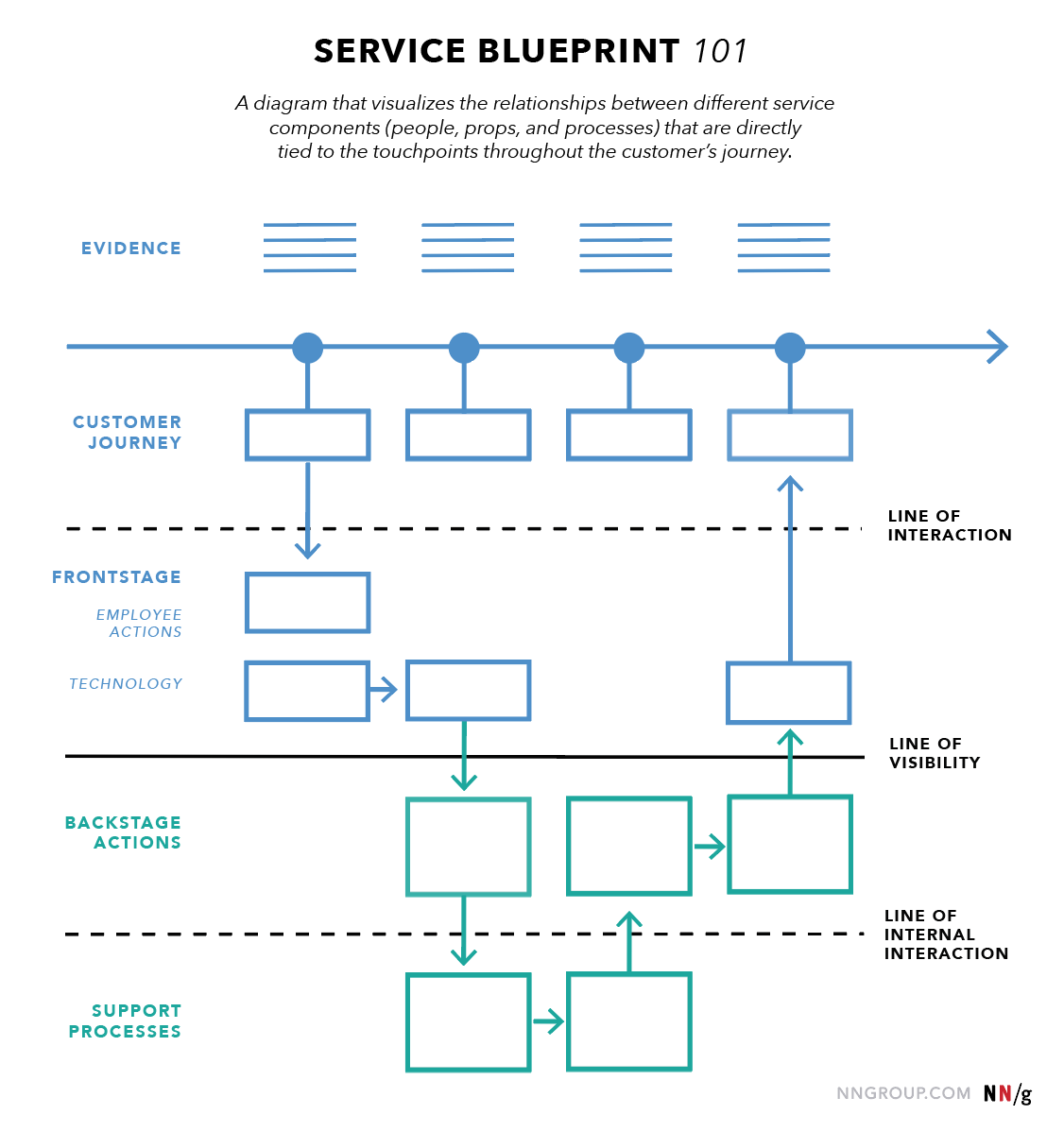
How do you align people, processes, technology, and policy so that what a person experiences at the front end is actually what the organization intended — and can deliver consistently, at scale? Service design plans and arranges people, infrastructure, communication and material components of a service in order to improve its quality, and the interaction between the service provider and its users. Its five principles, according to This Is Service Design Thinking, are: user-centered (services should be experienced through the customer’s eyes), co-creative (all stakeholders should be included in the service design process), sequencing (the service should be visualized as a sequence of interrelated actions [note this is oversimplified as not all services are linear, especially in the world of AI]), evidencing (intangible services should be visualized in terms of physical artifacts), and holistic (the entire environment of a service should be considered).
Elephant Energy, in Denver, Boston and LA, simplifies and streamlines the home electrification transition by providing, installing and maintaining residential heat pumps, heat pump water heaters, induction stoves, and home EV chargers. Elephant Energy conducts on-site assessment to determine options in a “Electrification Roadmap” that incorporates the customer’s home and goals. Understanding that rebates can be confusing and time consuming, the Elephant Energy team completes rebate paperwork for customers, requiring customers only to sign the drafted forms and to wait for the rebate check to arrive. Elephant Energy, understanding that financing, electrification expertise and a skilled workforce, and supply chain impact their ability to deliver a smooth and equitable electrification journey, actively build out strategic partnerships that streamline installations through a “one-stop”shop approach, and implement innovative financing models.
From the regulations to the economics to the technologies to the human factors involved, energy is a complex sector. Complexity is precisely where service design as a discipline excels in delivering value for customers and finding opportunities for optimization for service providers.
- Hyper-Local Service Ecosystems: With the innovation scale being driven on more local levels, service design provides the opportunity to map interactions across needs and resources in grid and municipal policy innovation initiatives.
- Predictive Service Design: IoT sensors and AI analytics are enabling companies to anticipate customer needs before problems arise, shifting from reactive maintenance to proactive service experiences that prevent outages and optimize performance automatically.
- Integrated Home Energy Services: The value chain can go beyond solar installation to design comprehensive energy management services that include EV charging, home batteries, smart thermostats, and energy trading, creating unified platforms for all household energy needs.
- Community-Ownership Service Models: Innovative service designs are emerging around community solar and energy cooperatives, where the customer journey involves collective decision-making, shared ownership structures, and peer-to-peer support systems rather than traditional vendor-customer relationships.
- Subscription-Based Energy Experiences: Companies are designing services that treat renewable energy as a lifestyle subscription rather than a one-time purchase, including ongoing optimization, technology upgrades, and performance guarantees that evolve with customers' changing needs over decades.
At its core, Service design orchestrates the backstage with the front stage and what the end customer experiences. Product and UX design are what the customer actually touches, the interface between the system and the person living inside it.
Product and User Experience Design
While product and user experience are two different disciplines, they both ask: How do you make technological experiences and products that add value to peoples lives in the energy transition? Product focuses more on a market fit, and user experience focuses on the end user, but ultimately they focus on creating and shaping a users’s experience with a particular product or service, with the goal of making them positive, pleasant and valuable for the end user. As we’ve already talked about, product and UX design isn’t about how a product looks, that’s just one aspect of the overall user experience. It’s about ensuring that the product or interface is logical, functional, easy to navigate and generally user-friendly. In clean energy, it creates digital and physical solutions that integrate renewable energy seamlessly into daily life and built environments.
One well known energy UX is Nest Thermostat, the best known reimagination of the analog thermostat to a connected device. Nest seeks to accommodate user’s needs at different times, allowing you to set a custom temperature at different times and on different days, even suggesting pre-set temperatures that balance comfort and energy saving. It allows you to track how much energy you use in a visually intuitive way, and helps find small optimizations to save energy, simplifying complex programming into intuitive scheduling. Most significantly, it moved the primary interface from the wall to your smart phone.
Another example is Tesla's Powerwall 3, which most solar installers will recommend above and beyond other options on the market. Their design challenge was to design an all-in-one home energy solution that integrates a battery, control system, and solar inverter into a single, streamlined unit that simplified installations and reduced costs for buyers. Tesla's approach demonstrates how product design can remove barriers to adoption by consolidating complex systems into elegant, user-friendly forms without compromising technical performance and residential integration. Ultimately, Tesla understood that clean energy products must fit into people's homes and lives, not the other way around.
Both of these examples begin to show the future of the energy user. These technologies offer enhanced ability to develop predictive energy relationship, helping people anticipate and prepare for their energy needs, using AI to suggest optimal times for high-energy activities, predict seasonal usage patterns, and automatically optimize energy trading in peer-to-peer markets. Already we see the importance of visualization and intelligence emerging, with apps allowing users to see how their consumption and production affects their immediate community and participate in local energy sharing and resilience planning. Or apps, like PlugShare, that crowdsource data on where to find EV chargers with the ability to report functionality and reviews for a real-time reliability network thats often more accurate than official infrastructure data. And importantly, these disciplines, along with service design, are delivering the sophisticated interfaces that solve the multi-network problem inherent in grid, EV, etc emerging technologies. For example, in EV charging, providing a single badge or pass that unlocks thousands of charging points across France and Europe eliminating the need to juggle five different cards. And all the while, working to make renewable systems seamlessly adapt to user patterns without requiring active management, making clean energy the path of least resistance.
Better products and services don't sell themselves, especially when they're asking people to change familiar habits. Communications design is what builds the cultural permission for adoption.
Communications Design
What do people need to know to understand the value and considerations of clean energy solutions in their day to day life? Communications design, the discipline we are all perhaps the most familiar with, creates visual and textual content that effectively conveys messages, builds understanding, and motivates action across diverse audiences. It encompasses graphic design, information design, campaign strategy, and media planning to create cohesive communication systems that can shift public opinion, educate stakeholders, and drive behavioral change. In the context of complex issues like energy policy, communications design has to translate technical information into accessible narratives while building trust and countering misinformation.

The Go Solar California! campaign, run by the California Energy Commission and the California Public Utilities Commission, encourages Californians to install 3,000 megawatts of solar energy systems on homes and businesses by the end of 2016. With a goal goal to install approximately 1,940 MW of new solar generation capacity, the campaign succeeded by combining clear, benefit-focused messaging with comprehensive educational resources and trusted messenger networks. Rather than leading with environmental arguments, the campaign emphasized economic benefits, energy independence, and technological innovation, meeting Californians where their motivations already existed. The visual identity used bright, optimistic imagery that associated solar energy with California's sunny lifestyle and technological leadership.
In the clean energy transition, value depends on context, so communications design has to connect benefits to specific community values and concerns, such as highlighting how community solar supports local businesses, or how offshore wind creates maritime jobs in coastal towns with fishing heritage. As our energy systems change, people need to be able to have trusted local messengers and culturally relevant narratives and that show how renewable energy investments can build community wealth and health.
—
Though these approaches are often not discussed or considered design in the energy sector, but they're present in every part: The policies that set the conditions, the strategies that build organizational will to act, the service infrastructure that makes the journey navigable, the products and interfaces that make clean energy something people actually want to live with, the communications that build a public ready for what's coming are the design work that is less visible. That’s because while the technology is an achievement to applaud, the hardest part is often how a transition becomes real and integrates into institutions, communities, and daily life.
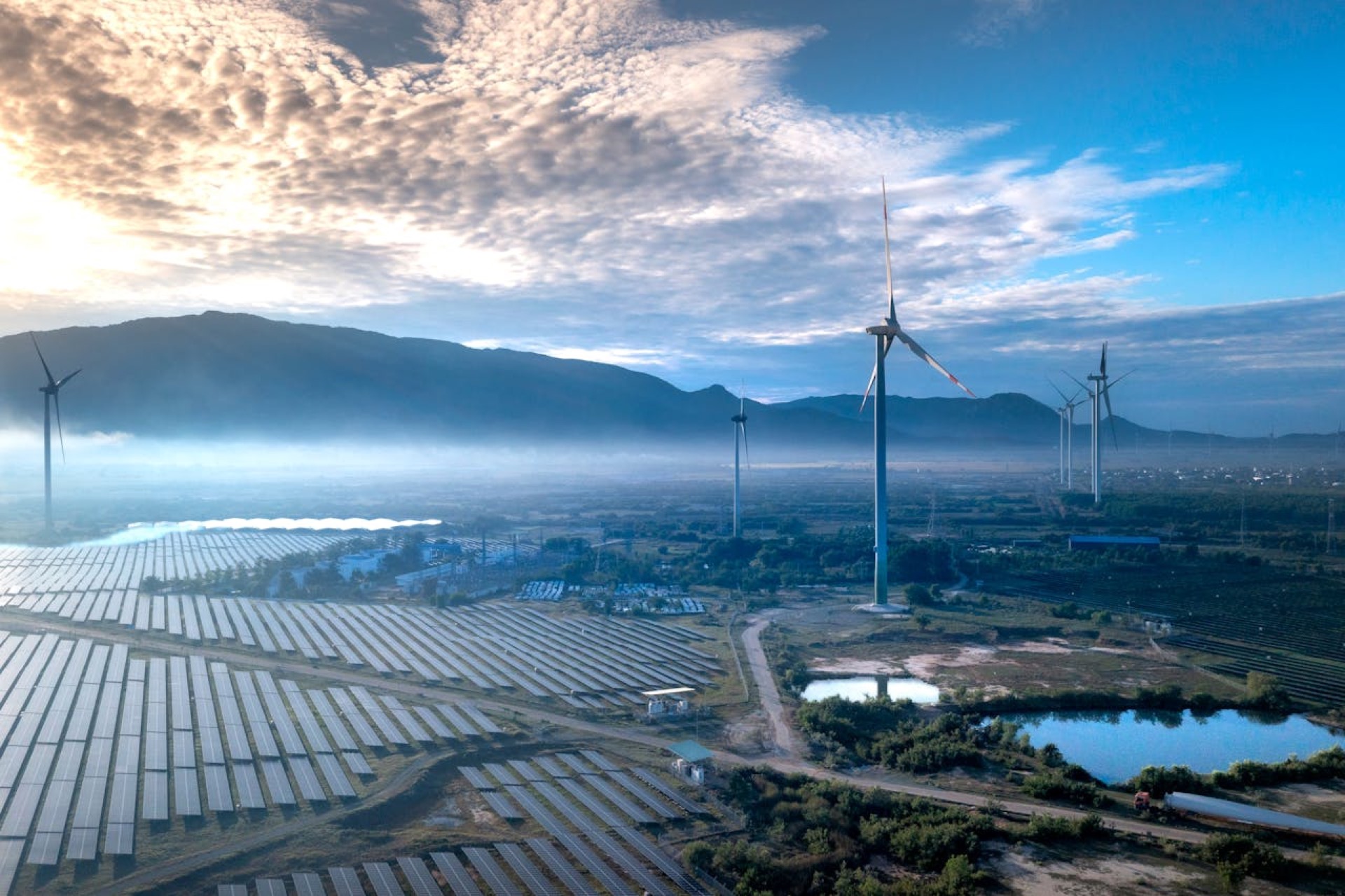
Header photo credits: Quang Nguyen Vinh